Embark on a journey into the world of Forex trading strategies with our comprehensive guide. Discover the key strategies that can help you navigate the dynamic currency markets with confidence and skill.
Learn how to leverage fundamental analysis, technical indicators, price action, risk management, and more to enhance your trading success.
Introduction to Forex Trading Strategies
Forex trading, also known as foreign exchange trading, involves the buying and selling of currencies in the global market. It is one of the largest and most liquid financial markets in the world, with trillions of dollars traded daily. Effective trading strategies are essential in the Forex market to help traders navigate the volatility and complexity of currency movements. These strategies provide a systematic approach to analyzing market trends, identifying entry and exit points, managing risk, and maximizing profits.
Benefits of Using Forex Trading Strategies
- Minimize risks: Trading strategies help traders mitigate potential losses by setting stop-loss orders and implementing risk management techniques.
- Improve decision-making: By following a set of rules and guidelines, traders can make informed decisions based on market analysis rather than emotions.
- Enhance consistency: Having a structured approach to trading can help maintain consistency in performance and results over time.
- Maximize profits: Forex trading strategies aim to capitalize on market opportunities and optimize profit potential through effective trading techniques.
Fundamental Analysis Strategy
Fundamental analysis in Forex trading involves evaluating the overall health of an economy by analyzing various economic indicators, policy decisions, and other factors that can influence the value of a currency.
Examples of Fundamental Factors
- Interest rates set by central banks
- Economic indicators such as GDP growth, employment rates, and inflation
- Political stability and geopolitical events
- Trade balance and current account deficits
How Traders Can Use Fundamental Analysis
Fundamental analysis can help traders anticipate long-term trends in currency prices based on the underlying economic conditions of a country. By staying informed about key economic indicators and events, traders can make more informed trading decisions. For example, if a country’s economy is showing signs of growth, traders may expect its currency to strengthen over time. On the other hand, negative economic news or political instability can lead to a currency losing value in the Forex market.
Technical Analysis Strategy
Technical analysis is a method used by traders to evaluate and forecast price movements in the forex market based on historical price data and trading volume. It involves studying charts and using various technical indicators to identify patterns and trends that can help predict future price movements.
Common Technical Indicators
There are several commonly used technical indicators by traders to analyze price movements in the forex market:
- 1. Moving Averages: These indicators smooth out price data to identify trends over a specific period.
- 2. Relative Strength Index (RSI): This indicator measures the speed and change of price movements to determine overbought or oversold conditions.
- 3. Bollinger Bands: These bands indicate volatility and potential price reversal points.
- 4. MACD (Moving Average Convergence Divergence): This indicator shows the relationship between two moving averages and helps identify trend reversals.
- 5. Fibonacci Retracement: This tool is used to identify potential support and resistance levels based on the Fibonacci sequence.
Effectiveness of Different Technical Analysis Tools
Each technical analysis tool has its strengths and weaknesses in predicting price movements. Moving averages are useful for identifying trends, while RSI helps determine overbought or oversold conditions. Bollinger Bands are effective in measuring volatility, and MACD can signal trend reversals. Fibonacci retracement levels can act as significant support or resistance levels. Traders often use a combination of these tools to make informed trading decisions based on technical analysis.
Price Action Strategy
Price action trading is a method used by Forex traders to make decisions based on the actual price movements of a currency pair, rather than relying on indicators or oscillators. This strategy focuses on analyzing historical price data to identify trends, key levels, and potential entry and exit points. Price action trading is significant in Forex trading as it helps traders gain a deeper understanding of market dynamics and make more informed trading decisions.
Using Price Action to Identify Trends
- Traders can use price action to identify trends by looking for patterns such as higher highs and higher lows in an uptrend, or lower highs and lower lows in a downtrend.
- Key levels such as support and resistance can also be identified through price action, helping traders determine potential entry and exit points.
- By analyzing price action, traders can gain insights into market sentiment and the strength of a trend, enabling them to make more accurate predictions about future price movements.
Price Action Patterns and Implications
- Common price action patterns include pin bars, engulfing candles, and inside bars, which can signal potential reversals or continuations in the market.
- For example, a bullish engulfing pattern where a large bullish candle engulfs a smaller bearish candle could indicate a reversal from a downtrend to an uptrend.
- Traders can also use multiple price action patterns in conjunction with other technical analysis tools to confirm their trading signals and improve the accuracy of their trades.
Risk Management Strategy
Effective risk management is crucial in Forex trading to protect capital and minimize losses. By implementing proper risk management techniques, traders can enhance their overall trading performance and increase their chances of long-term success.
Importance of Risk Management
- One of the key reasons why risk management is essential in Forex trading is to prevent significant losses that could wipe out trading accounts.
- Managing risk allows traders to control the amount of capital they are willing to risk on each trade, ensuring that they do not expose themselves to excessive risk.
- By implementing risk management strategies, traders can stay disciplined and avoid emotional decision-making, which often leads to impulsive trading and losses.
Different Risk Management Techniques
- Stop-loss orders: Setting stop-loss orders helps traders define their risk per trade by specifying the maximum amount they are willing to lose before exiting a losing position.
- Position sizing: This technique involves determining the appropriate position size based on the trader’s risk tolerance and the distance to the stop-loss level.
- Diversification: Spreading out risk across different currency pairs or asset classes can help minimize the impact of losses on a single trade.
Tips for Effective Risk Management
- Calculate risk-reward ratios before entering trades to ensure that potential profits justify the risk taken.
- Set realistic profit targets and avoid over-leveraging to maintain a healthy risk-to-reward ratio.
- Regularly review and adjust risk management strategies based on changing market conditions and individual trading performance.
Carry Trade Strategy
Carry trade is a popular Forex trading strategy that involves borrowing money in a currency with a low interest rate and investing it in a currency with a higher interest rate. This strategy aims to profit from the interest rate differentials between two currencies.
How Carry Trade Works
- Traders borrow money in a currency with a low interest rate, such as the Japanese Yen.
- They then invest this borrowed money in a currency with a higher interest rate, like the Australian Dollar.
- By holding onto this trade over time, traders can earn profits from the interest rate differential between the two currencies.
Potential Benefits of Carry Trade
- Opportunity for passive income generation from interest rate differentials.
- Potential for capital appreciation if the higher-yielding currency strengthens against the lower-yielding currency.
- Diversification of trading strategies by incorporating interest rate differentials into the overall trading approach.
Risks Associated with Carry Trade and Mitigation Strategies
- Exchange rate risk: Fluctuations in exchange rates can erode profits from interest differentials. Traders can use stop-loss orders to limit potential losses.
- Interest rate risk: Unexpected changes in interest rates can impact the profitability of carry trades. Traders should stay informed about central bank policies and economic indicators.
- Leverage risk: Using leverage amplifies both profits and losses in carry trades. Traders should exercise caution and use appropriate risk management techniques.
Trend Following Strategy
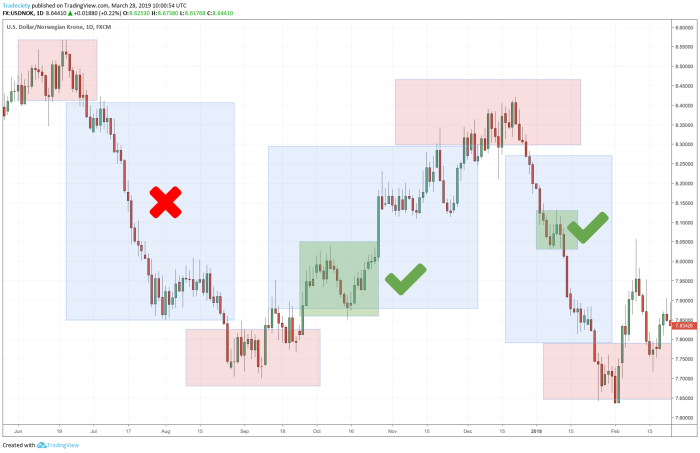
In Forex trading, a trend-following strategy involves identifying and following the direction of the market trend to make trading decisions. This approach assumes that the current price movement will continue in the same direction.
Methods for Identifying and Following Trends
- One common method is to use moving averages, where traders look for crossovers or the position of the price in relation to the moving average to determine the trend.
- Trendlines can also be drawn on price charts to visually represent the direction of the trend. Traders can enter trades based on breaks or bounces off these trendlines.
- Another approach is to use technical indicators like the Average Directional Index (ADX) to gauge the strength of a trend and decide whether to enter or exit trades.
Advantages and Disadvantages of Trend Following Strategy
- Advantages:
- Allows traders to ride profitable trends and capture significant price movements.
- Helps traders avoid counter-trend trades that could result in losses.
- Provides clear entry and exit signals based on the direction of the trend.
- Disadvantages:
- Trend-following strategies may result in missed opportunities during ranging or consolidating markets.
- Traders may experience whipsaws or false signals when the trend reverses suddenly.
- It requires patience and discipline to stick to the strategy even during periods of drawdowns.
Scalping Strategy
Scalping is a popular Forex trading strategy that involves making multiple trades throughout the day to profit from small price movements. Unlike other trading strategies that focus on long-term trends, scalping aims to capture quick profits by entering and exiting positions rapidly.
Tips for Successful Scalping
- Choose a liquid currency pair with tight spreads to increase trading opportunities.
- Set tight stop-loss orders to protect your capital from significant losses.
- Monitor economic news and events that could impact the market to make informed trading decisions.
- Use technical indicators like moving averages or Fibonacci retracements to identify entry and exit points.
- Practice disciplined risk management to avoid overleveraging and emotional trading.
Risks and Rewards of Scalping Strategy
While scalping can be profitable due to the high frequency of trades, it also comes with unique risks:
- High transaction costs from frequent trading can eat into profits.
- Market noise and rapid price fluctuations can lead to false signals and losses.
- Emotional stress and fatigue from constantly monitoring the market and making quick decisions.
It’s essential to balance the potential rewards of scalping with the risks involved to determine if this strategy aligns with your trading style and risk tolerance.
Explore the world of Forex trading strategies and take your trading game to the next level. Equip yourself with the knowledge and tools needed to make informed decisions and maximize your trading potential.
FAQ Section
What is fundamental analysis in Forex trading?
Fundamental analysis involves evaluating economic and political factors that can impact currency prices.
How can traders effectively manage risk in Forex trading?
Traders can manage risk by using techniques like stop-loss orders and proper position sizing.
What is scalping and how does it differ from other strategies?
Scalping is a strategy where traders aim to make small profits quickly, differing from longer-term strategies.