As Foreign Exchange Market Overview takes center stage, this opening passage beckons readers into a world crafted with good knowledge, ensuring a reading experience that is both absorbing and distinctly original. The dynamic realm of foreign exchange holds a wealth of insights waiting to be explored, shedding light on the intricate web of global currencies and their impact on the world economy.
FOREIGN EXCHANGE
Foreign exchange, also known as forex or FX, refers to the global marketplace where currencies are traded. It involves the buying, selling, and exchanging of different currencies at determined prices.The foreign exchange market plays a crucial role in the global economy by facilitating international trade and investment. It allows businesses to convert one currency into another, enabling them to engage in cross-border transactions.
This market also serves as a mechanism for governments, central banks, and financial institutions to manage their foreign exchange reserves and stabilize their economies.
Importance of Currencies and Exchange Rates
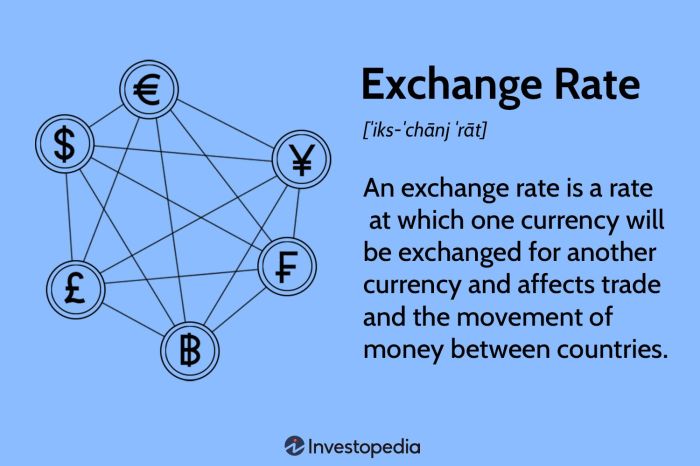
Currencies are the backbone of the foreign exchange market, as they are the medium of exchange used in international trade. Each currency has a specific value relative to others, which is determined by exchange rates. Exchange rates represent the price at which one currency can be exchanged for another and fluctuate based on various factors such as economic indicators, geopolitical events, and market sentiment.In essence, currencies and exchange rates are fundamental components of foreign exchange, influencing the flow of capital, investments, and trade between countries.
Understanding how they work is essential for businesses, investors, and policymakers to navigate the complexities of the global economy.
FOREIGN EXCHANGE MARKET OVERVIEW
The foreign exchange market, also known as the forex market, is a decentralized global marketplace where currencies are traded. It is the largest and most liquid financial market in the world, with a daily trading volume exceeding trillions of dollars.
Structure of the Foreign Exchange Market
The foreign exchange market is comprised of different layers, including the interbank market, retail market, and institutional market. The interbank market is where large financial institutions trade currencies among themselves, setting the exchange rates. The retail market involves individual traders and smaller financial firms, while the institutional market includes hedge funds, corporations, and central banks.
Participants in the Foreign Exchange Market
The participants in the foreign exchange market are diverse and include central banks, commercial banks, hedge funds, multinational corporations, governments, and individual traders. Each participant plays a unique role in influencing exchange rates and market dynamics. Central banks, for example, intervene in the market to stabilize their currencies, while hedge funds speculate on currency movements for profit.
Impact of Geopolitical Events on the Foreign Exchange Market
Geopolitical events such as wars, political instability, trade agreements, and economic sanctions can have a significant impact on the foreign exchange market. These events can cause currency values to fluctuate rapidly, leading to increased volatility and uncertainty in the market. Traders and investors closely monitor geopolitical developments to anticipate potential shifts in exchange rates and adjust their trading strategies accordingly.
MAJOR CURRENCY PAIRS
When it comes to the foreign exchange market, certain currency pairs stand out as the most traded and popular choices among traders. These major currency pairs have unique characteristics that set them apart from other pairs and play a significant role in global trade and investment.
Most Traded Currency Pairs
The most traded currency pairs in the foreign exchange market include:
- Euro/US Dollar (EUR/USD)
- US Dollar/Japanese Yen (USD/JPY)
- British Pound/US Dollar (GBP/USD)
- Australian Dollar/US Dollar (AUD/USD)
- US Dollar/Swiss Franc (USD/CHF)
- US Dollar/Canadian Dollar (USD/CAD)
These currency pairs are known for their high liquidity, meaning they can be easily bought or sold without significantly impacting the price. They also tend to exhibit lower volatility compared to exotic currency pairs, making them more predictable and stable for traders.
Influence on Global Trade and Investment
Major currency pairs play a crucial role in global trade and investment due to their widespread use in international transactions. For example, the EUR/USD pair is heavily traded in the forex market and is often considered a barometer for the health of the global economy. Fluctuations in major currency pairs can impact the competitiveness of exports and imports, influence investment decisions, and even affect inflation rates in different countries.
TRADING SESSIONS
In the foreign exchange market, trading sessions are crucial as they determine the periods when different regions are actively participating in trading. This creates distinct market dynamics based on the time zone and economic activities of each region.
Asian Trading Session
During the Asian trading session, markets in Tokyo, Singapore, and Hong Kong are active. This session overlaps with the European trading session, leading to increased volatility as traders from both regions are actively participating. Major currency pairs involving the Japanese Yen (JPY) are most actively traded during this session.
European Trading Session
The European trading session includes major financial centers like London, Frankfurt, and Zurich. This session is known for high liquidity and is considered the most significant due to the large volume of trades involving the Euro (EUR). The overlap with the Asian trading session creates a period of heightened trading activity.
North American Trading Session
The North American trading session involves markets in New York and Toronto. This session sees a continuation of trading activity from the European session, leading to significant liquidity. The U.S. Dollar (USD) is the most traded currency during this session, with major economic data releases impacting trading volumes.
Overlapping trading sessions create opportunities for traders to capitalize on increased volatility and liquidity.
In conclusion, the Foreign Exchange Market Overview unravels the complexities of currency trading, offering a glimpse into the interconnected nature of global finance. By delving into the nuances of major currency pairs, trading sessions, and geopolitical influences, one can better grasp the mechanisms driving this crucial market.
Query Resolution
What is the foreign exchange market?
The foreign exchange market is where currencies are traded globally, facilitating international trade and investment.
How do geopolitical events impact the foreign exchange market?
Geopolitical events can cause fluctuations in exchange rates, affecting currency values and trading volumes.
Which major currency pairs are most traded?
The major currency pairs include EUR/USD, USD/JPY, GBP/USD, and USD/CHF, among others.
Why is it important to understand trading sessions in the forex market?
Understanding trading sessions helps traders know when markets are most active and when to execute trades for optimal results.