Currency Exchange Rates Today sets the stage for this enthralling narrative, offering readers a glimpse into a story that is rich in detail with casual formal language style and brimming with originality from the outset.
Understanding how different currencies stack up against each other is crucial in today’s global economy. Dive into the world of currency exchange rates and discover the factors that drive this financial landscape.
Introduction to Currency Exchange Rates Today
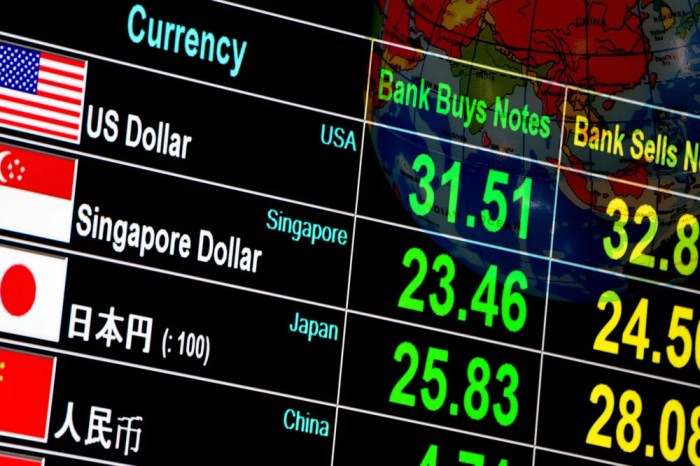
Understanding currency exchange rates is essential in the global economy, as it determines the value of one currency in relation to another. These rates fluctuate daily based on various factors.
Factors Influencing Currency Exchange Rates
- Economic indicators such as GDP, inflation, and employment rates play a significant role in determining exchange rates.
- Political stability and government policies can impact currency values as well.
- Market speculation and demand for a particular currency can cause fluctuations in exchange rates.
Importance of Monitoring Exchange Rates Daily
Monitoring exchange rates daily is crucial for businesses engaged in international trade, investors, and travelers. It allows them to make informed decisions regarding currency conversions, investments, and budgeting.
Understanding Foreign Exchange Markets
The foreign exchange market, also known as the forex market, is where currencies are traded globally. It is the largest and most liquid financial market in the world, with trillions of dollars exchanged daily.
Overview of Currency Trading in Forex Market
In the forex market, currencies are traded in pairs. For example, in the EUR/USD pair, the euro is the base currency, and the US dollar is the quote currency. The exchange rate indicates how much of the quote currency is needed to purchase one unit of the base currency.
- Currency pairs are quoted with bid and ask prices, where the bid price is the price at which the market buys the currency pair, and the ask price is the price at which the market sells the currency pair.
- Forex trading occurs 24 hours a day, five days a week, allowing traders from around the world to participate at any time.
- Leverage is commonly used in forex trading, allowing traders to control larger positions with a smaller amount of capital.
Role of Banks and Financial Institutions
Banks and financial institutions play a crucial role in currency exchange by facilitating transactions for individuals, businesses, and governments. They provide services such as currency conversion, hedging, and trading to meet the needs of their clients.
- Central banks are major players in the forex market, as they can influence exchange rates through monetary policy decisions.
- Commercial banks act as intermediaries for retail traders and institutional investors, offering trading platforms and market liquidity.
- Financial institutions provide research and analysis on currency markets, helping clients make informed trading decisions.
Factors Affecting Currency Exchange Rates
Understanding the various factors that influence currency exchange rates is crucial for traders, investors, and businesses operating in the global market. Economic indicators, geopolitical events, and interest rates all play a significant role in determining the value of a country’s currency.
Economic Indicators Impact
Economic indicators such as GDP growth, inflation rates, unemployment figures, and trade balances can have a direct impact on currency exchange rates. Positive economic data signals a strong economy, leading to an appreciation of the currency. On the other hand, negative economic indicators can cause a depreciation of the currency.
Geopolitical Events Influence
Geopolitical events, such as wars, political instability, and trade disputes, can create uncertainty in the market and impact currency values. For example, a country facing political turmoil may experience a decrease in the value of its currency as investors seek safer assets.
Interest Rates Effect
Interest rates set by central banks have a significant influence on currency exchange rates. Higher interest rates attract foreign investment as they offer higher returns. This increased demand for the currency can lead to an appreciation. Conversely, lower interest rates can result in a depreciation of the currency.
Methods to Monitor Currency Exchange Rates
Monitoring currency exchange rates is crucial for individuals and businesses involved in international transactions. Here are some effective methods to keep track of exchange rate fluctuations:
Real-time Exchange Rate Tracking Tools and Websites
There are various online platforms and websites that provide real-time updates on currency exchange rates. Some popular options include:
- XE Currency: A reliable platform offering live exchange rates, charts, and currency converter tools.
- Bloomberg Currency Calculator: Provides comprehensive data on exchange rates, market trends, and analysis.
- Investing.com: Offers a wide range of currency pairs with real-time quotes and customizable features.
Currency Converter Apps for Travelers
For travelers looking to convert currencies quickly and accurately, currency converter apps are convenient tools to have on hand. These apps allow users to calculate exchange rates on the go and compare prices in different currencies. Some popular currency converter apps include:
- Xe Currency Converter: Allows users to convert over 180 currencies and provides real-time exchange rates.
- XE Currency App: Offers live exchange rates, historical charts, and currency conversion features for travelers.
- Currency Converter Plus: A user-friendly app with offline functionality and support for multiple languages.
Significance of Historical Exchange Rate Data
Historical exchange rate data plays a crucial role in analyzing past trends, forecasting future movements, and making informed decisions. By examining historical exchange rates, individuals and businesses can identify patterns, assess risks, and develop strategies to mitigate currency fluctuations. This data provides valuable insights into market behavior and can guide financial planning and investment decisions.
As we wrap up this exploration of Currency Exchange Rates Today, it’s clear that staying updated on these fluctuations is key for anyone involved in international transactions or travel. Keep an eye on the numbers and make informed decisions based on the dynamic nature of currency exchange rates.
General Inquiries
What are currency exchange rates?
Currency exchange rates represent the value of one currency compared to another and determine how much one currency is worth in terms of another.
How do economic indicators impact exchange rates?
Economic indicators like GDP, inflation rates, and employment numbers can influence the strength of a country’s currency and its exchange rate.
Why is monitoring exchange rates daily important?
Monitoring exchange rates daily helps individuals and businesses make informed decisions about international transactions, investments, and travel expenses.