Diving into the world of Forex Trading with Leverage, this introduction captivates readers with a detailed yet engaging overview of how leverage can amplify gains and losses in the foreign exchange market.
Exploring the intricacies of leverage in Forex trading, this paragraph sets the stage for a deep dive into the risks and rewards of using leverage to boost trading potential.
Understanding Forex Trading with Leverage
Forex trading, also known as foreign exchange trading, involves the buying and selling of currencies in the foreign exchange market. Traders aim to profit from the fluctuations in exchange rates between different currencies.Leverage in the context of Forex trading refers to the ability to control a large position in the market with a relatively small amount of capital. It allows traders to amplify their potential profits by using borrowed funds from their broker.
For example, with a leverage ratio of 1:100, a trader can control a position worth $100,000 with only $1,000 of their own capital.
The Benefits of Using Leverage in Forex Trading
- Increased trading power: Leverage allows traders to open larger positions than they could with their own capital, potentially leading to higher profits.
- Capital efficiency: By using leverage, traders can make the most of their available capital and take advantage of more trading opportunities.
- Diversification: Leverage enables traders to diversify their trading portfolio by entering into multiple positions with relatively small amounts of capital.
- Enhanced liquidity: With leverage, traders can participate in the market more actively and execute trades quickly, taking advantage of short-term opportunities.
Risks Associated with Forex Trading with Leverage
When trading Forex with leverage, there are significant risks that traders need to be aware of. Leverage can amplify both gains and losses, making it a powerful tool that requires careful consideration and risk management.
Potential Risks of Trading Forex with Leverage
- Leverage magnifies the impact of market fluctuations: While leverage can increase profits, it can also amplify losses if the market moves against your position. Traders need to be cautious as even a small adverse movement can result in significant losses.
- Margin calls and liquidation: Trading with leverage involves borrowing funds from a broker, and if the trade moves in the wrong direction, it can lead to margin calls or liquidation of the position. This can result in losing more than the initial investment.
- Emotional trading: The potential for high returns with leverage can lead to emotional decision-making, such as holding losing positions for too long in the hope of a turnaround. This can further exacerbate losses.
Impact of Leverage on Trading Decisions
- Increased risk-taking: Traders may be tempted to take on larger positions than they would with their own capital, leading to higher risk exposure.
- Overtrading: The availability of leverage can encourage frequent trading, which can result in increased transaction costs and potential losses.
- Unrealistic profit expectations: Leverage can create a false sense of security and overconfidence, leading traders to expect unrealistically high profits without fully understanding the risks involved.
How Leverage Works in Foreign Exchange
Leverage plays a crucial role in Foreign Exchange trading by allowing traders to control positions larger than their initial investment. Let’s dive into how leverage operates in the world of Forex trading.
Calculating Leverage in Foreign Exchange
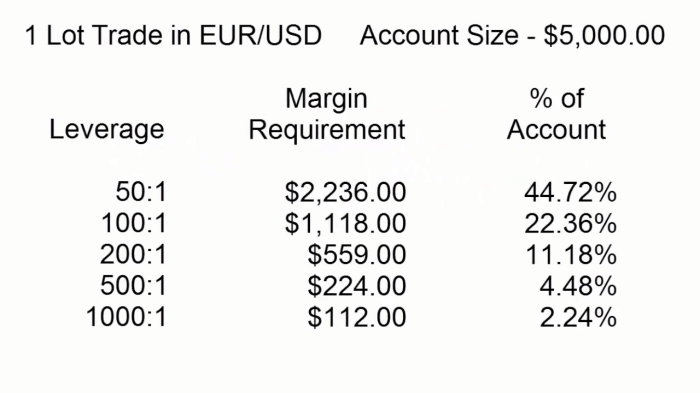
When it comes to Forex trading, leverage is typically expressed as a ratio, such as 50:1 or 100:This ratio represents the amount of capital a trader can control compared to their initial investment. For example, with a leverage ratio of 50:1, a trader can control a position worth $50,000 with a $1,000 investment.
Role of Margin Requirements
Margin requirements are essential when trading with leverage as they determine the amount of capital a trader needs to maintain in their account to support their open positions. Margin is the initial investment required to open a position, and maintaining this margin is crucial to avoid margin calls or liquidation of positions.
Impact of Leverage on Profit Potential
Leverage can significantly amplify profit potential in Forex trading. By controlling larger positions with a smaller initial investment, traders can potentially earn higher returns. However, it’s important to remember that leverage also magnifies losses, so risk management is crucial to navigate the volatile Forex market effectively.
Strategies for Managing Leverage in Forex Trading
Effective management of leverage is crucial for success in Forex trading, as it can amplify both gains and losses. Here are some tips for managing leverage responsibly:
Utilize Stop-Loss Orders
One of the most important risk management strategies when using leverage is setting stop-loss orders. These orders automatically close a trade when it reaches a certain level of loss, helping to limit potential losses.
Diversify Your Portfolio
Diversification is key to managing risk in Forex trading. By spreading your investments across different currency pairs, you can reduce the impact of a single trade going against you.
Use Proper Position Sizing
Proper position sizing is essential when trading with leverage. By determining the correct lot size based on your account size and risk tolerance, you can ensure that a single trade does not wipe out your entire account.
Monitor Margin Levels
Monitoring your margin levels is crucial when using leverage. Maintaining adequate margin levels ensures that you have enough funds in your account to sustain your trades without facing margin calls or liquidation.
Stay Informed and Educated
Continuously educating yourself about the Forex market and staying informed about economic events can help you make better trading decisions. Understanding market trends and factors that influence currency prices can improve your ability to manage leverage effectively.
In conclusion, Forex Trading with Leverage offers lucrative opportunities but comes with its fair share of risks. By understanding how leverage works and implementing effective risk management strategies, traders can navigate the complex world of Forex with confidence.
FAQ Guide
What is the maximum leverage typically offered in Forex trading?
Maximum leverage in Forex trading can vary by broker but is commonly set at 50:1 or 100:1.
How can traders mitigate the risks associated with leverage in Forex trading?
Traders can mitigate risks by setting stop-loss orders, diversifying their portfolio, and avoiding over-leveraging their positions.
Does leverage impact the profit potential in Foreign Exchange trading?
Yes, leverage can amplify both profits and losses, significantly affecting the profit potential in Foreign Exchange trading.