With Foreign Exchange Risk Management at the forefront, this paragraph opens a window to an amazing start and intrigue, inviting readers to embark on a storytelling journey filled with unexpected twists and insights.
Foreign exchange plays a crucial role in global trade, but it also comes with risks that need effective management strategies. This guide dives into the various facets of foreign exchange risk management to help businesses navigate the complex world of currency fluctuations and market dynamics.
Introduction to Foreign Exchange
Foreign exchange, often referred to as Forex or FX, is the global marketplace for trading and exchanging different currencies. It plays a crucial role in facilitating international trade and investment by allowing businesses and individuals to convert one currency into another.
Foreign Exchange Markets and Currency Trading
The foreign exchange market is the largest and most liquid financial market in the world, where currencies are bought and sold. It operates 24 hours a day, five days a week, across different time zones. Participants in the market include banks, financial institutions, corporations, governments, and individual traders.
- Currencies are traded in pairs, such as EUR/USD (Euro/US Dollar) or USD/JPY (US Dollar/Japanese Yen).
- Trading in the foreign exchange market involves buying one currency and selling another simultaneously.
- Transactions in the market can be done over-the-counter (OTC) or through electronic trading platforms.
Exchange Rates and Business Impact
Exchange rates represent the value of one currency in terms of another and play a significant role in determining the cost of international transactions. Fluctuations in exchange rates can impact businesses in various ways.
Exchange rates are influenced by factors such as interest rates, inflation, political stability, and economic performance.
- Businesses engaged in international trade are exposed to foreign exchange risk due to potential losses from unfavorable exchange rate movements.
- Companies may use hedging strategies to manage foreign exchange risk, such as forward contracts, options, or currency swaps.
- Exchange rate movements can affect a company’s competitiveness, profitability, and financial performance in the global market.
Foreign Exchange Risk Management Strategies
Foreign exchange risk management is crucial for companies to protect themselves from potential losses due to fluctuations in currency exchange rates. By implementing effective strategies, companies can mitigate risks and ensure stability in their financial operations.
Types of Foreign Exchange Risks
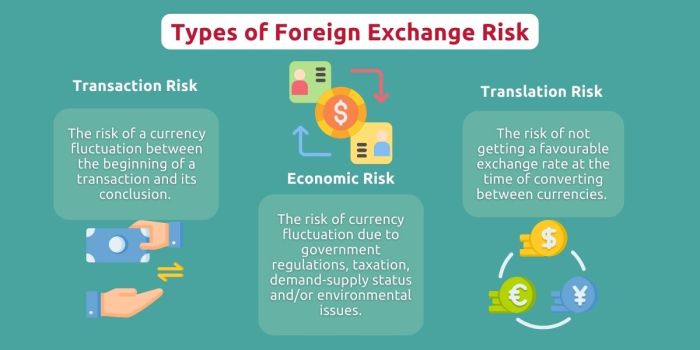
Companies face various types of foreign exchange risks, including:
- Transaction Risk: Arises from fluctuations in exchange rates between the transaction date and settlement date.
- Translation Risk: Results from the conversion of financial statements of foreign subsidiaries into the parent company’s reporting currency.
- Economic Risk: Caused by unexpected changes in exchange rates impacting the value of a company’s investments or cash flows.
Importance of Foreign Exchange Risk Management
Effective foreign exchange risk management is essential for companies to:
- Protect profits and cash flows from currency fluctuations.
- Enhance predictability and stability in financial planning.
- Maintain competitiveness in global markets.
Foreign Exchange Risk Management Strategies
Companies can utilize various strategies to manage foreign exchange risks, such as:
- Hedging: Involves using financial instruments to offset potential losses from adverse exchange rate movements.
- Forward Contracts: Agreements to buy or sell currencies at a predetermined rate on a future date to hedge against currency risk.
- Options: Provide the right, but not the obligation, to exchange currencies at a specified rate within a set period.
- Swaps: Involve exchanging cash flows in different currencies to reduce exposure to exchange rate fluctuations.
Hedging Techniques for Foreign Exchange Risk
When it comes to managing foreign exchange risk, hedging plays a crucial role in protecting businesses from potential losses due to currency fluctuations. Hedging involves taking strategic positions or entering into financial contracts to offset the risk of adverse movements in exchange rates.
Forward Contracts
One popular hedging technique is the use of forward contracts. These contracts allow businesses to lock in a specific exchange rate for a future date, providing certainty in the face of volatile currency markets. Companies can use forward contracts to hedge their exposure to foreign currency risk by agreeing to buy or sell a specified amount of currency at a predetermined rate.
Currency Options
Another common hedging strategy is the use of currency options. These financial instruments give businesses the right, but not the obligation, to exchange currencies at a predetermined rate within a specified timeframe. Currency options provide flexibility and protection against unfavorable exchange rate movements, as companies can choose whether or not to exercise the option based on market conditions.
Examples of Hedging in Practice
- Company A, a U.S.-based exporter, enters into a forward contract to sell euros and lock in a favorable exchange rate to protect against potential depreciation of the euro.
- Company B, a multinational corporation, purchases currency options to hedge its exposure to multiple currencies and mitigate the impact of exchange rate fluctuations on its global operations.
- Company C, a small business importing goods from overseas, uses a combination of forward contracts and options to manage currency risk and ensure stable pricing for its imported products.
Challenges in Foreign Exchange Risk Management
Managing foreign exchange risk comes with a set of challenges that companies need to navigate in order to protect their financial interests.
External Factors Impacting Foreign Exchange Risk
External factors such as geopolitical events, economic indicators, and market volatility can significantly impact foreign exchange risk management strategies.
- Geopolitical Events: Unforeseen political events such as elections, trade disputes, or conflicts can lead to sudden fluctuations in exchange rates, making it difficult for companies to predict and manage their currency exposure.
- Economic Indicators: Changes in economic indicators like inflation rates, interest rates, and GDP growth can also influence currency values, posing a challenge for companies trying to mitigate foreign exchange risk.
- Market Volatility: Fluctuations in the financial markets due to factors like investor sentiment, global economic conditions, or natural disasters can increase the uncertainty and risk associated with foreign exchange transactions.
Adapting Risk Management Strategies
Companies can adapt their risk management strategies to overcome these challenges by implementing the following tactics:
- Hedging Techniques: Utilizing hedging instruments such as forward contracts, options, or currency swaps can help companies protect against adverse currency movements and minimize potential losses.
- Diversification: Spreading currency exposure across different currencies or regions can reduce the impact of a single currency fluctuation on the company’s overall financial performance.
- Monitoring and Analysis: Regularly monitoring and analyzing market trends, economic indicators, and geopolitical events can help companies make informed decisions and adjust their risk management strategies accordingly.
In conclusion, mastering foreign exchange risk management is essential for companies operating in the global market. By understanding the strategies, techniques, and challenges involved, businesses can safeguard their financial interests and thrive in the face of currency volatility.
Questions Often Asked
How can companies mitigate foreign exchange risks?
Companies can use strategies like hedging, forward contracts, options, and swaps to manage and minimize foreign exchange risks.
What are some common challenges in foreign exchange risk management?
Common challenges include dealing with geopolitical events, economic indicators, and market volatility that can impact exchange rates and business operations.