Embark on a journey through the intricate world of Foreign Exchange Market Analysis, delving into the complexities that drive the global economy and shape currency valuations.
Explore the fundamental principles, key players, and critical factors that influence this dynamic market.
Introduction to Foreign Exchange Market
The foreign exchange market, also known as the forex market, is a decentralized global marketplace where currencies are traded. It is the largest and most liquid financial market in the world, with an average daily trading volume exceeding $6 trillion.
The significance of the foreign exchange market in global economics cannot be overstated. It plays a crucial role in facilitating international trade and investment by allowing businesses to convert one currency into another. Exchange rates determined in this market affect the cost of imports and exports, influencing a country’s trade balance and overall economic health.
Major Participants in the Foreign Exchange Market
- Commercial banks: Banks act as intermediaries in the forex market, facilitating transactions for their clients and engaging in speculative trading.
- Hedge funds: Hedge funds participate in the forex market to profit from changes in currency prices through speculation and arbitrage.
- Central banks: Central banks play a pivotal role in the foreign exchange market by setting monetary policy, managing currency reserves, and intervening to stabilize exchange rates.
- Multinational corporations: Multinational companies engage in the forex market to manage currency risk associated with their international operations and transactions.
- Retail traders: Individual investors and retail traders also participate in the forex market through online trading platforms to speculate on currency movements.
Functions of the Foreign Exchange Market
The foreign exchange market serves several key functions that are essential for global trade and investment. These functions help facilitate the exchange of currencies and determine exchange rates.
Primary Functions of the Foreign Exchange Market
- Facilitates Currency Conversion: One of the primary functions of the foreign exchange market is to provide a platform for converting one currency into another. This is crucial for international trade and investment.
- Provides Liquidity: The market ensures that there is ample liquidity, allowing participants to buy and sell currencies easily. This liquidity helps stabilize exchange rates.
- Determines Exchange Rates: Exchange rates are determined in the foreign exchange market based on supply and demand dynamics. When the demand for a currency is high, its value appreciates, and vice versa.
How Exchange Rates are Determined
Exchange rates in the foreign exchange market are influenced by various factors such as interest rates, inflation, political stability, and economic performance. The interaction of these factors determines the value of a currency relative to others.
Role of Speculation in the Foreign Exchange Market
Speculation plays a significant role in the foreign exchange market as traders and investors attempt to profit from fluctuations in exchange rates. Speculators engage in buying and selling currencies based on their expectations of future price movements.
Types of Foreign Exchange Transactions
Foreign exchange transactions encompass a variety of methods used for trading currencies across different countries. These transactions play a crucial role in the global economy, facilitating international trade and investment.
Spot Transactions vs. Forward Transactions
Spot transactions involve the immediate exchange of currencies at the current market rate. This type of transaction is settled within two business days. On the other hand, forward transactions involve an agreement to exchange currencies at a future date and a predetermined exchange rate. This allows parties to hedge against currency fluctuations and manage risks associated with foreign exchange.
Options and Swaps in Foreign Exchange Transactions
Options give the buyer the right, but not the obligation, to exchange currencies at a specified rate within a certain timeframe. This provides flexibility and protection against unfavorable exchange rate movements. Swaps, on the other hand, involve the exchange of currencies at the current rate with an agreement to reverse the transaction at a future date. This helps manage cash flows and reduce risks associated with currency fluctuations.
Factors Influencing Foreign Exchange Rates
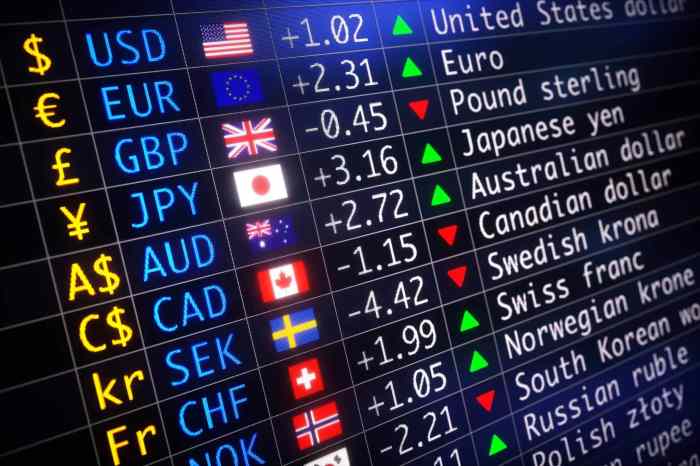
Foreign exchange rates are influenced by a variety of factors that can lead to fluctuations in currency values. Understanding these factors is crucial for investors, businesses, and policymakers to make informed decisions in the foreign exchange market.
Economic Indicators Impact
Economic indicators play a significant role in influencing foreign exchange rates. Factors such as GDP growth, inflation rates, unemployment levels, and interest rates can all impact a country’s currency value. For example, a country with a strong GDP growth rate and low inflation is likely to have a stronger currency compared to a country with a weaker economic performance.
Political Stability and Geopolitical Events
Political stability and geopolitical events can also have a major impact on exchange rates. Uncertainty or unrest in a country can lead to a decrease in investor confidence, causing the currency to depreciate. On the other hand, a stable political environment can attract foreign investments and strengthen the currency.
Major Currency Pairs in Foreign Exchange Trading
When it comes to the foreign exchange market, there are several major currency pairs that are commonly traded by investors and traders worldwide. These currency pairs are known for their high liquidity and trading volume, making them popular choices for those looking to engage in forex trading.
List and Description of Major Currency Pairs
- Euro/US Dollar (EUR/USD): This is the most traded currency pair in the forex market, representing two of the largest economies in the world.
- US Dollar/Japanese Yen (USD/JPY): Known for its stability, this pair is often used as a safe haven by investors during times of market uncertainty.
- British Pound/US Dollar (GBP/USD): Also known as Cable, this pair is influenced by economic developments in the UK and the US.
- Australian Dollar/US Dollar (AUD/USD): This pair is heavily influenced by commodity prices and the economic performance of Australia.
- US Dollar/Canadian Dollar (USD/CAD): Known as the Loonie, this pair is influenced by oil prices and economic data from both countries.
Concept of Base and Quote Currencies
In a currency pair, the first currency listed is known as the base currency, while the second currency is the quote currency. The exchange rate indicates how much of the quote currency is needed to purchase one unit of the base currency. For example, in the EUR/USD pair, EUR is the base currency and USD is the quote currency.
Characteristics and Trading Volume of Popular Currency Pairs
| Currency Pair | Characteristics | Trading Volume |
|---|---|---|
| EUR/USD | High liquidity, tight spreads | Most traded pair in the forex market |
| USD/JPY | Stable, influenced by global economic trends | One of the most traded pairs in Asia |
| GBP/USD | Volatility due to Brexit and economic data | Popular pair among traders |
| AUD/USD | Affected by commodity prices and economic data | High trading volume during Asian session |
| USD/CAD | Correlated with oil prices and economic data | Often traded alongside commodity currencies |
Technical Analysis in Foreign Exchange Market
Technical analysis is a method used to evaluate and predict future price movements in the foreign exchange market based on historical price data. It focuses on analyzing charts and patterns to identify trends and make informed trading decisions.
Common Technical Indicators
- Moving Averages: Moving averages help smooth out price data to identify trends over a specific period.
- Relative Strength Index (RSI): RSI measures the speed and change of price movements to determine if a currency is overbought or oversold.
- Bollinger Bands: Bollinger Bands indicate volatility and potential price breakouts by plotting standard deviations around a moving average.
- MACD (Moving Average Convergence Divergence): MACD shows the relationship between two moving averages to identify trend changes.
Application of Technical Analysis
Technical analysis can be applied in various ways to predict currency price movements. For example, traders may use moving averages to identify trends and potential entry or exit points for trades. RSI can help traders determine when a currency is reaching extreme levels and may reverse its direction. Bollinger Bands are used to identify periods of low volatility that may precede significant price movements.
MACD can signal potential changes in trend direction based on the relationship between moving averages.
In conclusion, Foreign Exchange Market Analysis unveils a realm where economic indicators, geopolitical events, and market speculation converge to determine currency values, offering insights into the heartbeat of international finance.
Question Bank
What are the most traded currency pairs in the foreign exchange market?
The most traded currency pairs include EUR/USD, USD/JPY, and GBP/USD.
How do economic indicators impact foreign exchange rates?
Economic indicators such as GDP growth, employment rates, and inflation can influence currency values by signaling the health of an economy.
What is the significance of options and swaps in foreign exchange transactions?
Options and swaps provide risk management tools for participants in the foreign exchange market to hedge against currency fluctuations.